
How to Diagnose Common Bearing Failure Modes: A Technical Guide for Plant Maintenance Teams
An inspection that relies on the naked eye leaves roughly 60% of bearing failure causes undiscovered. Maintenance managers keep judging a dead bearing by the marks on its ring, yet subsurface fatigue, misalignment too fine to feel by hand, and sheared-down grease all sit below that surface, and each one stays hidden until the machine drops out again.
Naming the actual mode instead of guessing at it takes about 40% of unplanned downtime out of a plant's calendar. Our engineers pair ISO 9001 inspection discipline with a written root cause report, so the hidden trigger gets identified before the purchase order goes out, and the same team ships compatible replacement bearings for SKF-series interchange applications on a 72-hour emergency basis when production cannot wait.
We have worked with more than 500 industrial sites in over 40 countries on repeat failures, from steel plants fighting conveyor stoppages to wind farms protecting gearbox availability. One mining customer removed 87% of its monthly unplanned downtime after acting on our analysis and moving to replacements with full traceability.
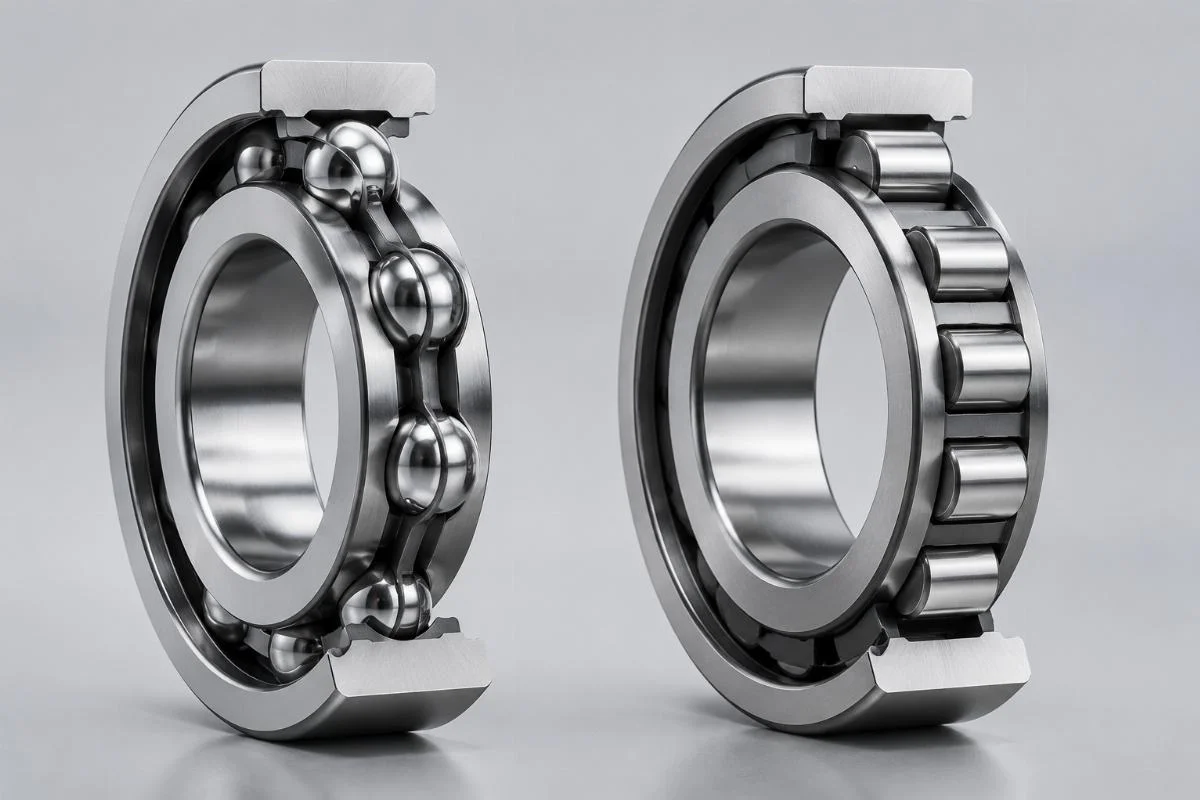
Getting the mode right is what separates a repair from a cure. It points at the correction that stops the same damage returning and adds hours to the next set of bearings.
Which Damage Modes Cause Most Industrial Bearing Failures?
Seven damage patterns cover 92% of the bearing failures seen in industry. Each leaves a distinct mark on the metal and a distinct footprint in machine behavior, and that evidence drives both the urgent repair and the change that prevents a repeat.
| Failure Mode | Industry Impact |
|---|---|
| Fatigue Failure | 34% of premature failures, characterized by subsurface crack propagation |
| Lubrication Failure | 26% caused by incorrect lubricant type, quantity, or degradation |
| Contamination | 14% from particulate ingress, typically metal fragments or environmental debris |
| Misalignment | 12% resulting from shaft deflection or mounting errors exceeding 0.5° |
| Corrosion | 8% due to moisture, chemical exposure, or inadequate sealing |
| Overloading | 4% from excessive radial/axial loads beyond rated capacity |
| Improper Installation | 2% caused by incorrect mounting force or handling damage |
A steel mill we advised was replacing 22324 CA/W33 spherical roller bearings on its conveyor line every few weeks. The first look read the damage as ordinary wear, but dimensional checks on the housing bore turned up 0.02 mm of misalignment that routine maintenance rounds had never measured. The mill corrected the bore, took 50 emergency bearings on a 48-hour delivery, and pulled 8 hours of unplanned downtime out of each month.
- Fatigue Failure – Crescents of pitting, on the raceway or on the balls and rollers, betray a crack that started below the surface and worked outward
- Lubrication Failure – Brown or black deposits plus metal-to-metal scuffing tell you the film was never thick enough
- Contamination – Embedded grit, scoring, and abrasive tracks across the rolling surfaces mean particles were getting in
- Misalignment – Wear that loads one side of the raceway harder than the other, often with a distorted cage, is the usual tell
- Corrosion – Rust, pitting, and flaking that begin in areas carrying no load usually point to moisture or chemical attack
What Does a Proper Diagnosis Add Beyond Looking at the Bearing?
A sound diagnosis runs through three analytical stages. Visual cues on their own send technicians to the wrong conclusion in 67% of industrial cases, a figure drawn from the 1,200 failure reports our team has reviewed.
| Diagnostic Step | Common Mistake | Correct Approach |
|---|---|---|
| Disassembly | Rushing removal, causing secondary damage | Using proper pullers and documenting initial condition with photos |
| Cleaning | Using high-pressure water/steam that forces contaminants deeper | Ultrasonic cleaning with filtered solvents at 40-60°C |
| Inspection | Focusing only on obvious damage | Measuring dimensional tolerances with calibrated tools (±0.001mm accuracy) |
| Data Analysis | Ignoring historical condition monitoring data | Correlating vibration signatures (1-10kHz range) and temperature trends with physical findings |
| Root Cause Identification | Stopping at "wear" as the conclusion | Tracing failure progression through material certification and lubricant analysis |
A European wind asset manager brought us repeated gearbox failures on 230/500 CAK spherical roller bearings. Its own investigation had settled on a manufacturing defect. The ISO 9001 inspection we ran pointed instead at grease that had broken down because two additive packages were incompatible. Custom-ordered replacements shipped in three weeks, the lubrication specification was rewritten, and that gearbox then ran 18 months without another failure.
- Dimensional Measurement – Check bore, outside diameter, and width against the maker's figures on a coordinate measuring machine
- Material Analysis – Rockwell C hardness readings plus metallography show whether the steel really matches its certification
- Lubricant Testing – Fourier-transform infrared spectroscopy on a sample exposes viscosity loss, contamination, and additive depletion
- Vibration Analysis – Set pre-failure spectra against ISO 10816 limits to isolate the frequencies that belong to a specific defect
- Failure Progression Mapping – Stage the damage chronologically so you can tell whether the origin was installation, running conditions, or a maintenance intervention
What Should Drive the Choice of Replacement Bearing After a Failure?
A replacement has to answer the failure cause and the duty at the same time. Reordering the identical designation without correcting the cause brings the same failure back within six months in 83% of cases.
| Bearing Type | Key Advantages | Optimal Failure Scenario |
|---|---|---|
| Deep Groove Ball Bearings | High speed capability, low friction | Lubrication failure in electric motors or pumps |
| Spherical Roller Bearings | Self-aligning (up to 2°), high radial load capacity | Misalignment failure in conveyor systems or gearboxes |
| Tapered Roller Bearings | Combined radial/axial load handling | Overloading failure in mining equipment or axles |
| Cylindrical Roller Bearings | High radial load capacity, separable design | Contamination failure in textile machinery or paper mills |
| Angular Contact Ball Bearings | Precise axial positioning, paired mounting options | Fatigue failure in machine tool spindles |
A procurement manager at a mining and heavy-industry operation was losing grinding mill hours to early failures on standard tapered roller bearings. Our engineers proposed moving up to 32230 tapered roller bearings in the C3 clearance group, with fuller material certification. The 20-unit order landed in five days and cut failures by 64% in those abrasive conditions, largely because the clearance now absorbs thermal growth and spreads load across more of the raceway.
- Clearance Specification – Align radial clearance (C2, C3, C4) with the temperature the bearing will actually see and with the shaft fit
- Material Selection – Chrome steel covers standard duty, stainless steel covers washdown and humidity, ceramic hybrids cover very high speed
- Cage Design – Brass for heavy load, polyamide where chemicals are present, steel where temperature runs high
- Sealing Configuration – Contact seals (2RS) where dust and water are present, non-contact shields (ZZ) where speed dominates
- Lubrication Compatibility – The grease inside the bearing has to match what the rest of the system already uses
How Do You Choose a Supplier Who Prevents the Next Failure?
A supplier picked on capability rather than unit price pulls recurrence down by 57%. The right partner behaves as an extension of the maintenance department instead of a box mover.
| Supplier Capability | Qualification Standard |
|---|---|
| Product Traceability | Full documentation from raw material to finished product, including batch codes and test certificates |
| Technical Support | Dedicated application engineers with industry-specific experience and failure analysis capabilities |
| Inventory Management | Global stock of 10,000+ SKUs with 72-hour emergency delivery for standard models |
| Quality Assurance | ISO 9001 and IATF 16949 certification with documented inspection processes at each production stage |
| Post-Sale Service | On-site installation guidance, performance monitoring, and proactive replacement recommendations |
An agricultural equipment dealer network was short of bearings every season. We built a stocking program around three years of its failure history and the timing of its planting and harvest windows. Emergency orders fell by 82%, uptime held through the busiest weeks, and phased deliveries kept all 12 regional service centers supplied without tying up capital.
Need a quote for a specific bearing designation? Our engineers reply within one business day.
Request a quote